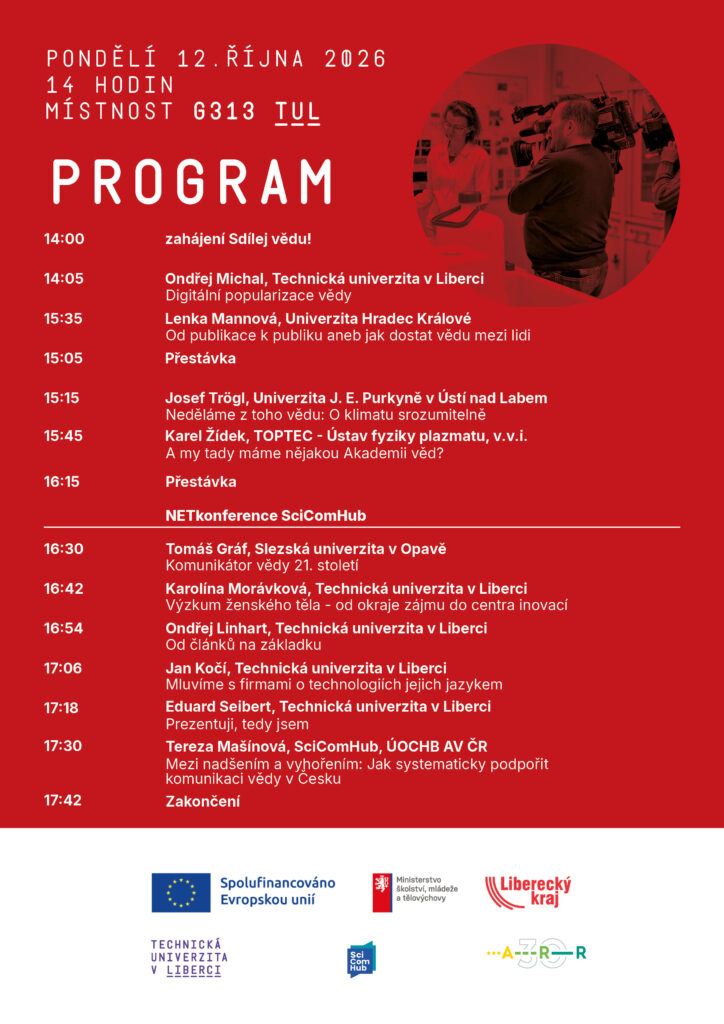
Karel Žídek received one of Europe’s most prestigious ERC grants. Thanks to her research, Karolína Morávková made it to the finals of the Falling Walls Lab in Berlin. Eduard Seibert captivated the world with a lamp created with the help of bees.
They have one thing in common: they’re doing cutting-edge science outside of Prague.
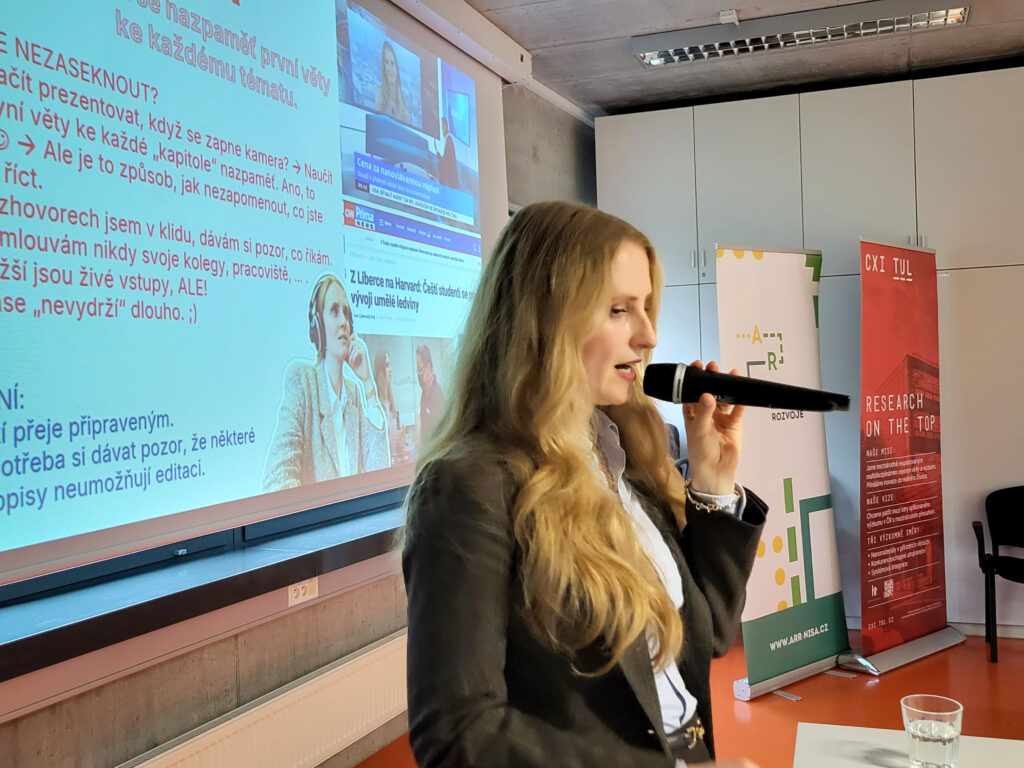
And that is precisely the theme of this year’s “Sdílej vědu!” conference, which will take place on October 12 at the Technical University of Liberec and is supported by the Regional Development Agency in collaboration with the Liberec Region.
How can cutting-edge research from the regions be communicated in a way that reaches people, businesses, and the media?
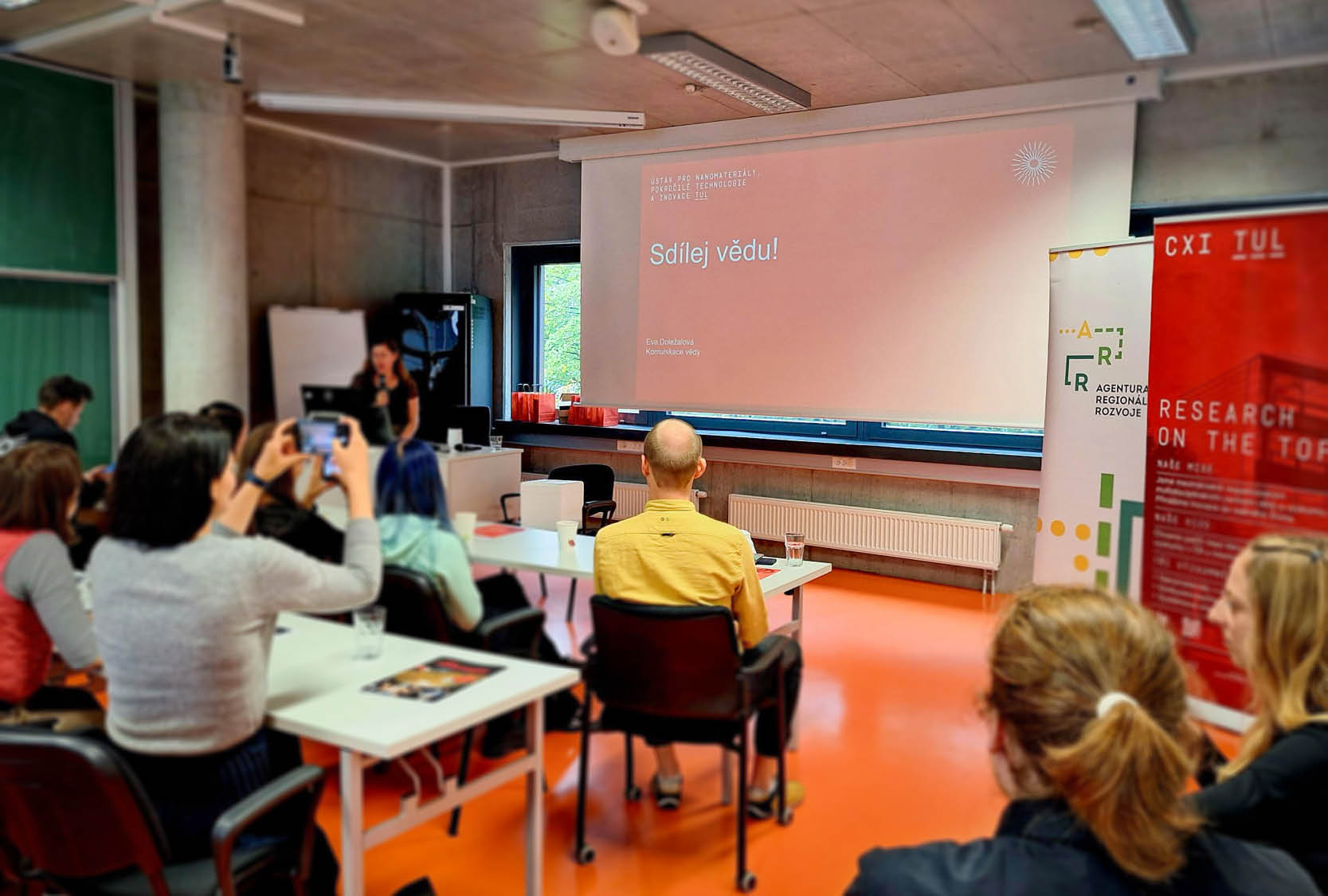
“When I spoke with the individual speakers, it naturally became clear that science communication at regional universities has its own specific characteristics. We operate in a different environment than large universities in big cities. This makes it all the more important to share experiences and find approaches that really work,” says Eva Doležalová, conference organizer and science communicator at the Institute for Nanomaterials, Advanced Technologies, and Innovation (CXI TUL) at the Technical University of Liberec.
Science Must Be Visible
One such path leads through social media. Ondřej Michal, head of the Communications and Marketing Department at TUL, will highlight their potential for popularizing science.
“The digital age calls for digital communication. If a university wants to effectively popularize its scientific findings, it must enter the realm of social media. Fortunately, it’s not complicated at all; you just need to communicate clearly, authentically, and engagingly,” says Michal.
And that, he believes, is where marketing can help science—not by changing its content, but by finding ways to get it to the audience.
“Science is a high-quality product. What matters most is how we manage to bring it closer to people,” he adds.
In his lecture on the digital popularization of science, he’ll present specific examples of how universities and scientists can use social media to reach a broad audience. Using data from TUL, he’ll also demonstrate that more thoughtful communication and clear visuals can significantly increase the reach of scientific content.
Communication Is Not an Afterthought
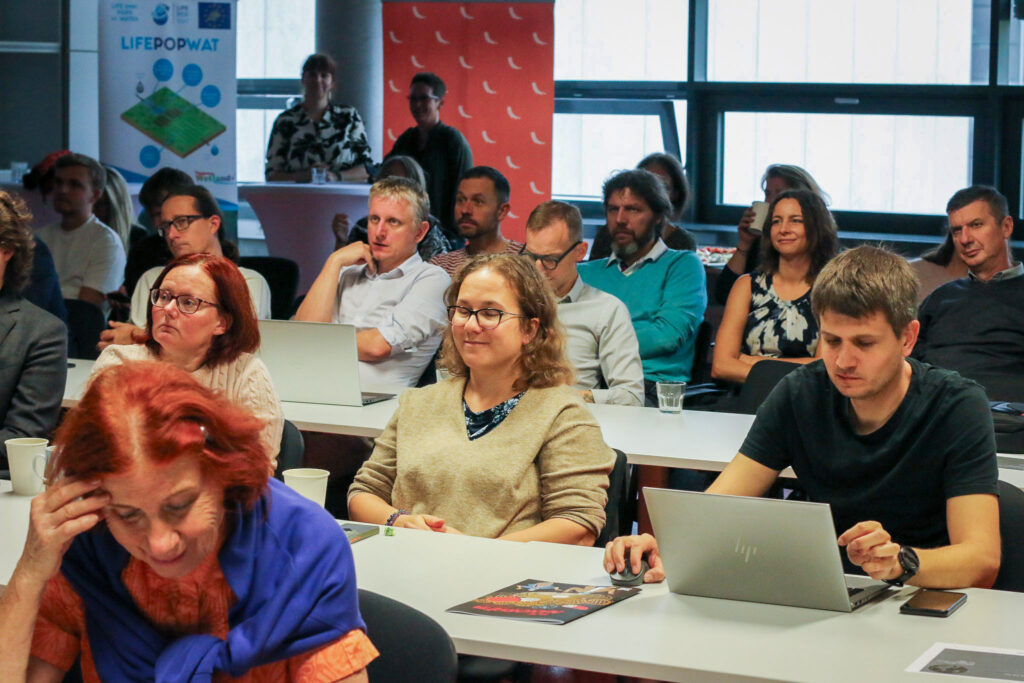
Today, cutting-edge research does not end with publication. It only has a real impact when it reaches people, companies, or policymakers.
Karel Žídek from the TOPTEC Center at the Institute of Plasma Physics of the Czech Academy of Sciences, a recent recipient of an ERC Consolidator Grant, therefore poses a question that strikes at the very heart of the academic environment.
“We routinely present our results to colleagues as an integral part of our work. Why is communication beyond this boundary still just a burdensome extra for some scientists?”
Don’t make a science out of it. But don’t resort to oversimplification either
How can we explain climate change to people who don’t have time to read through scientific studies? Josef Trögl from the Faculty of Environmental Studies at UJEP argues that the key lies in simplicity—but not the kind that strips the topic of its context.
“Communicating environmental research requires ‘not making a science out of it,’ but at the same time not succumbing to ‘global oversimplification,’” he says.
According to him, it is precisely excessive oversimplification that can distort complex environmental issues, whether on social media or in the news.
Every piece of research has its own story
Popularizing science doesn’t start with a dry press release. It starts with finding a story.
Lenka Mannová from the University of Hradec Králové will show that even behind the most complex scientific study lies a topic that the general public can understand—if someone can tell it well.
Who will communicate science tomorrow?
Social media, artificial intelligence, and new formats are changing the way we communicate science today. But they don’t change what matters most.
Astrophysicist Tomáš Gráf from Silesian University in Opava points out a simple fact.
“The form of science communication doesn’t really matter. The facts do.”
Enthusiasm Isn’t Enough
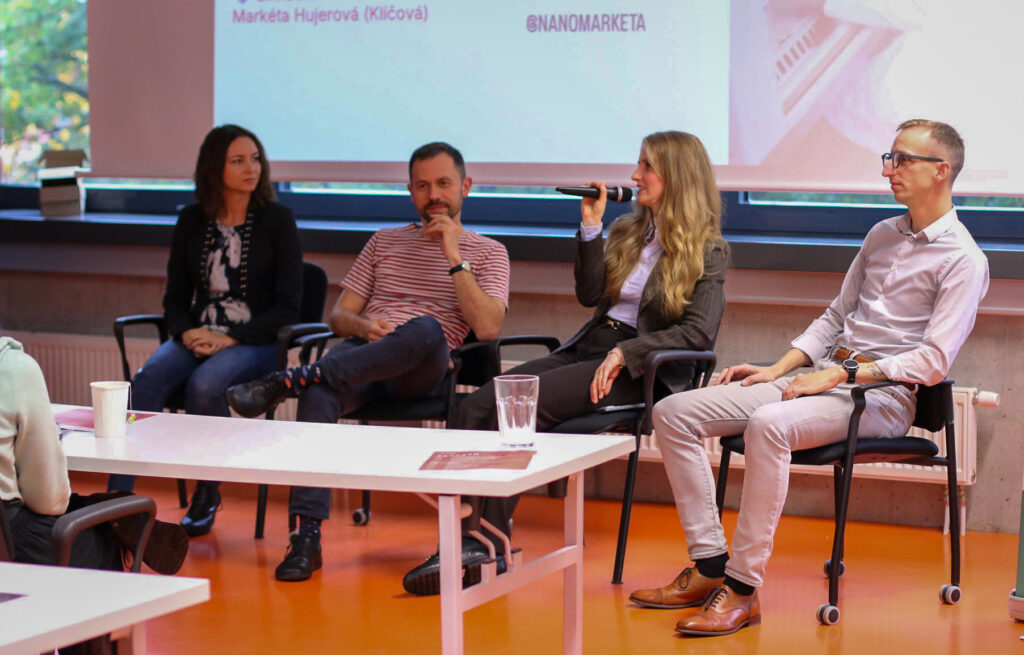
Most high-quality science communication today relies on people who do it alongside their main jobs. But according to Tereza Mašínová of the Institute of Organic Chemistry and Biochemistry of the Czech Academy of Sciences, this is not sustainable in the long term.
“High-quality science communication and popularization require time, experience, and resources. They cannot be built on volunteer work.”
Research on the Female Body—From the Margins of Interest to the Center of Innovation
Reproductive biotechnologist Karolína Morávková from CXI TUL is developing nanofiber systems for delivering drugs to the gynecological environment. It was for this work that she won an award in the Falling Walls Lab competition and advanced to the international finals in Berlin.
“Women’s reproductive health has long been somewhat neglected by science. But that’s changing. It’s not only an important research topic, but also a great example of how much it matters how science is discussed to the outside world,” says Morávková.
Talking to Companies About Technology in Their Own Language
Developing a new technology is not enough. Real impact only comes when companies understand it, adopt it, and turn it into innovation.
This is precisely what Jan Kočí from CXI TUL has been focusing on for a long time; he connects research teams with industry and helps companies put new technologies into practice. In his lecture, he will demonstrate why communication is just as important as the research itself and how to talk about technologies in a way that resonates with the people who decide how to use them.
His work demonstrates that the success of innovations is often determined not only by the quality of the technology, but also by the ability to explain its benefits to the people who can use it.
When Students Teach
It doesn’t always have to be a professor who gives a lecture. Ondřej Linhart from the Faculty of Economics at TUL will show that sometimes it is the students themselves who have the greatest impact. In a project focused on supporting social entrepreneurship, they are the ones who visit elementary and secondary schools.
“Together with the Liberec Region and the Regional Development Agency, we are developing a project to support social entrepreneurship. Our students teach at schools instead of academics. The first school visits showed that the project is off to a successful start,” says Linhart.
Good science isn’t enough. You have to know how to present it
In science, we spend years learning to conduct research, work with data, formulate conclusions, and defend them before the professional community. However, we devote much less time to learning how to present our own work to the people around us.
This is precisely what Eduard Seibert, an architect, designer, and doctoral student at the TUL Faculty of Arts and Architecture, points out.
“For many scientific activities, self-presentation is more important than mathematics. How many semesters have we devoted to it?” he asks.
He himself demonstrates just how powerful a story can be when it straddles disciplines. In his work, he brings together architecture, design, research, and the world of bees. His “Beehive” light fixture was not created merely as a design object, but as the result of human collaboration with a natural process.
Science as Part of Regional Development
Stories like these show that science communication isn’t just about how science is perceived from the outside. In the regions, it can also determine whether research findings are put into practice and transformed into new opportunities for businesses and people alike.
“Cutting-edge research is taking place in the Liberec Region. But it’s not enough to come up with something great and then hope that someone will notice it. We need to know how to bring science out of the labs and into businesses and among people. That’s exactly how new ideas, companies, and jobs with higher added value are created. And it’s also the reason why talented people come to study, work, and live in the Liberec Region,” concludes Edvard Kožušník, Deputy Governor for Economic and Strategic Development of the Liberec Region.
“Share Science!” and the follow-up NET conference will demonstrate that the quality of research does not depend on a ZIP code. Whether it changes the world is often determined by how well we can communicate it.