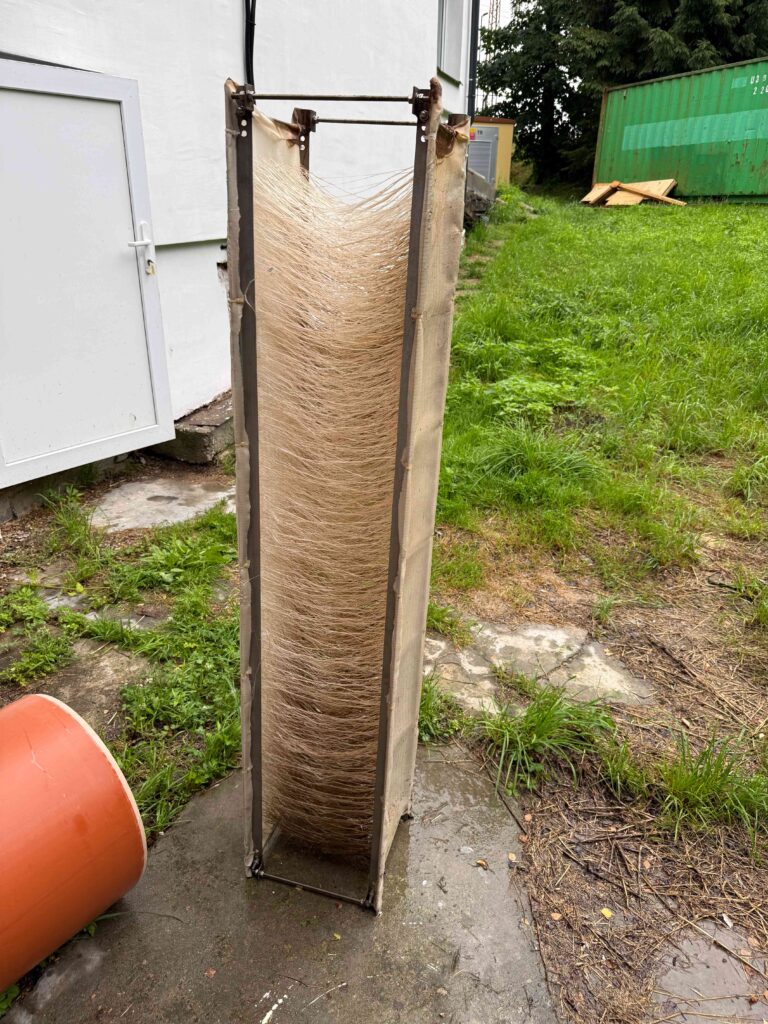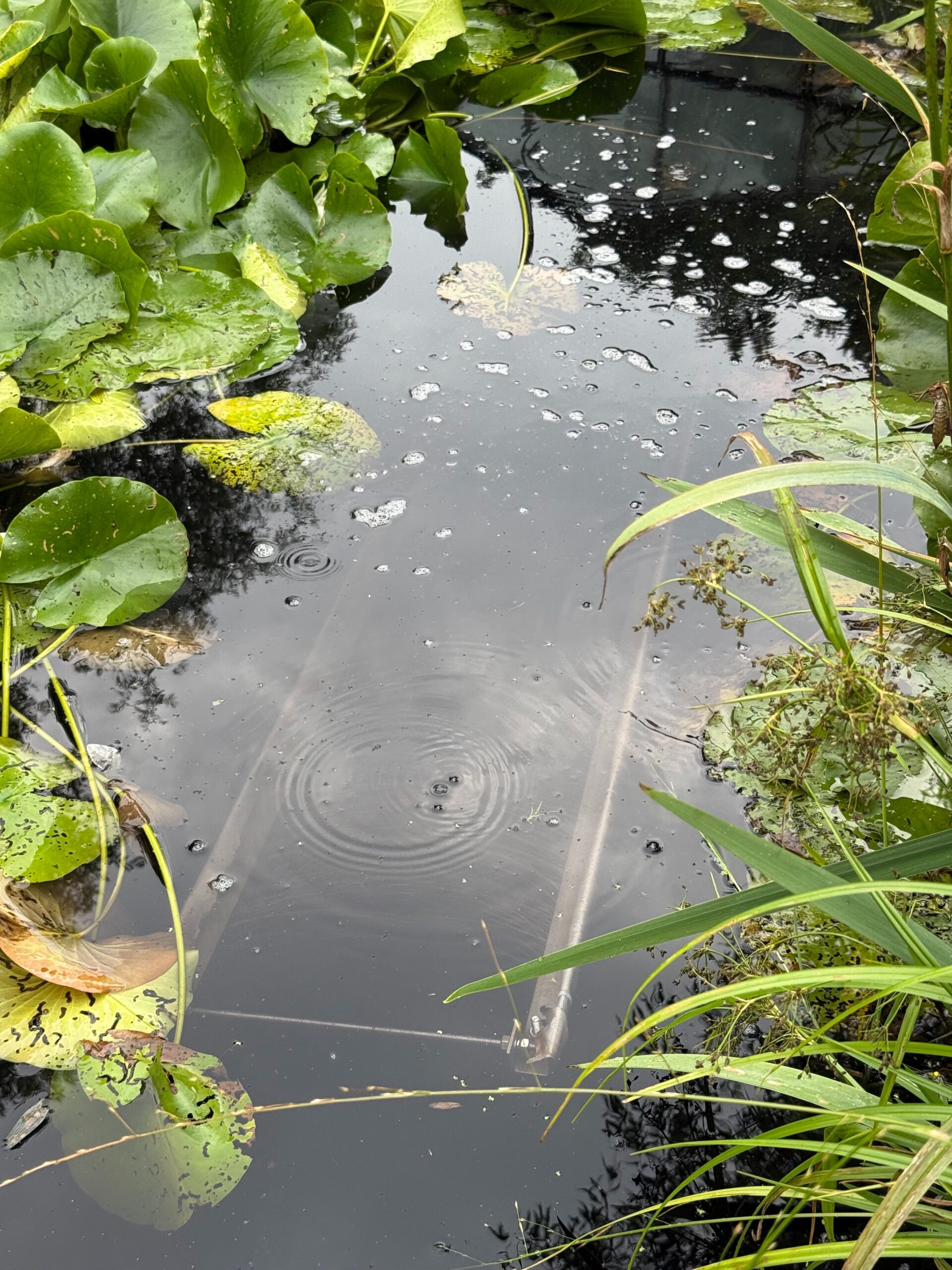
At first glance, it looks like a simple setup. Inside, however, microorganisms are at work, helping to further purify the water. Karel Havlíček from CXI TUL and his team combined bacteria with a 3D nanofibrous carrier and tested the solution both at a wastewater treatment plant and in an ordinary garden pond.
Wastewater treatment has relied on microorganisms for more than a hundred years. In treatment plants, bacteria use substances dissolved in the water for their growth while at the same time removing organic pollutants and, to some extent, nitrogen compounds.
This principle, known as the activated sludge process, still forms the basis of biological wastewater treatment today. However, requirements for treated water quality are increasing, and even after conventional treatment, some undesirable substances may remain.
One of them is ammoniacal nitrogen. At higher concentrations, it can harm aquatic organisms. In fish, it can damage the gills, impair breathing and, at high concentrations, even lead to death.
The activated sludge process is therefore a good foundation. Sometimes, however, an additional treatment step is needed.
And that is one of the issues Karel Havlíček and his team at CXI TUL focused on in their project.
Bacteria need a place to stay
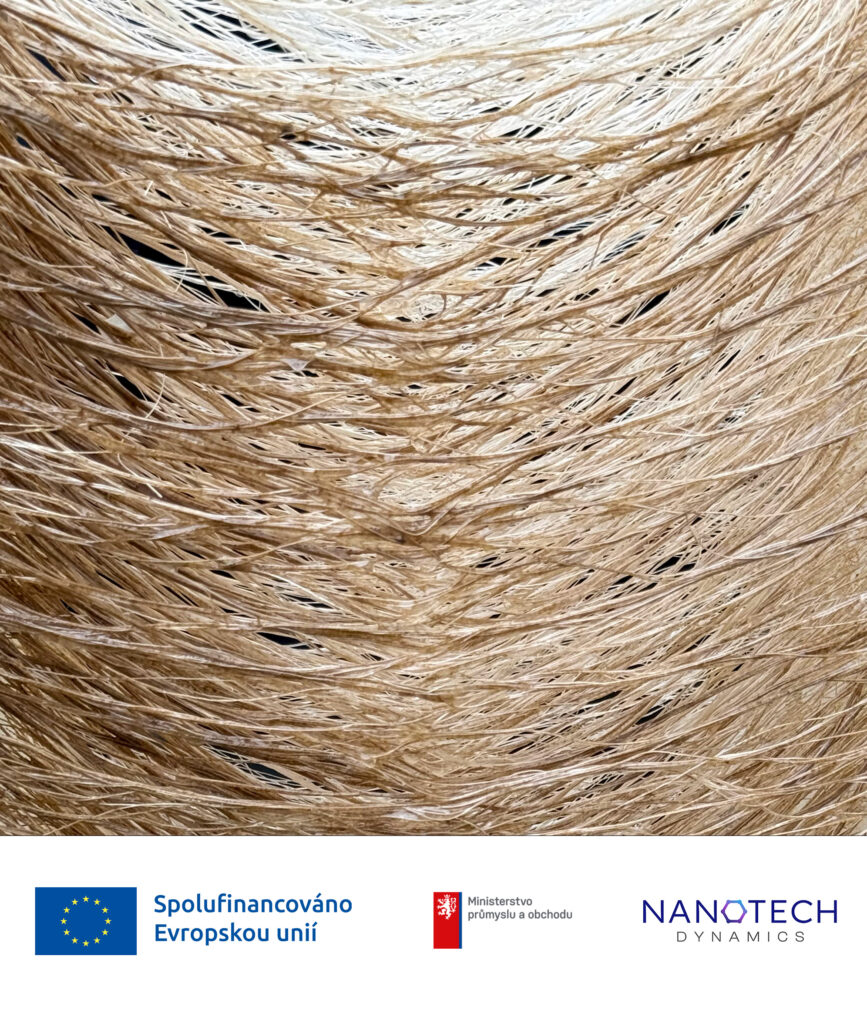
The developed technology is once again based on microorganisms, but this time they are attached to nanofibrous yarn and selected according to the task they are expected to perform in the water. For example, they can remove ammoniacal nitrogen or help eliminate unwanted nutrients from pond water.
Nanofibres were chosen because they have an exceptionally large surface area, allowing bacteria to attach easily and form a biofilm. It works a little like Velcro on a microscopic scale: the bacteria have something to cling to, so they are not easily washed away by the flowing water.
Together with the Liberec-based companies Nanotech dynamics and VÚTS, the team scaled up the nanofibrous yarn into a larger structure. The result was a three-dimensional material mounted on a simple framework made of metal rods.
The final product is a large 3D nanofibrous biomass carrier that can be placed directly into a wastewater treatment tank or another system through which water flows, such as a garden pond.
At the treatment plant, down to zero
One of the test sites was the wastewater treatment plant in Liberec. The team worked there with water that had already passed through the main treatment process. It was here that the effectiveness of the carrier became particularly evident. In the tested system, it was able to reduce ammoniacal nitrogen to zero values, even though its concentration at the inlet fluctuated.
The second test took place in an ordinary garden pond with water lilies. During a hot and dry summer, water in such ponds is replaced less frequently, heats up, may become cloudy and can begin to smell.
For the pond, the team used microorganisms commonly found in commercial water-treatment products. These are usually simply poured into the pond. In a flow-through system, however, some are washed away by the water and some settle at the bottom in the sediment. On the nanofibrous carrier, by contrast, the bacteria attach themselves, form a biofilm, remain in place and continue treating the pond water.
By pre-colonising the 3D nanofibrous carrier with the required bacteria, thus creating a 3D carrier with a biological component, the system gains a major advantage in the subsequent treatment process.
“We could see that the water quality in the pond was improving,” Karel Havlíček explained.
The team had actually expected conditions to deteriorate during the period of severe drought. The water was warmer and less water was flowing into the pond. Nevertheless, concentrations of ammoniacal nitrogen, phosphorus and total organic carbon continued to decrease.
A bioreactor for a few thousand crowns
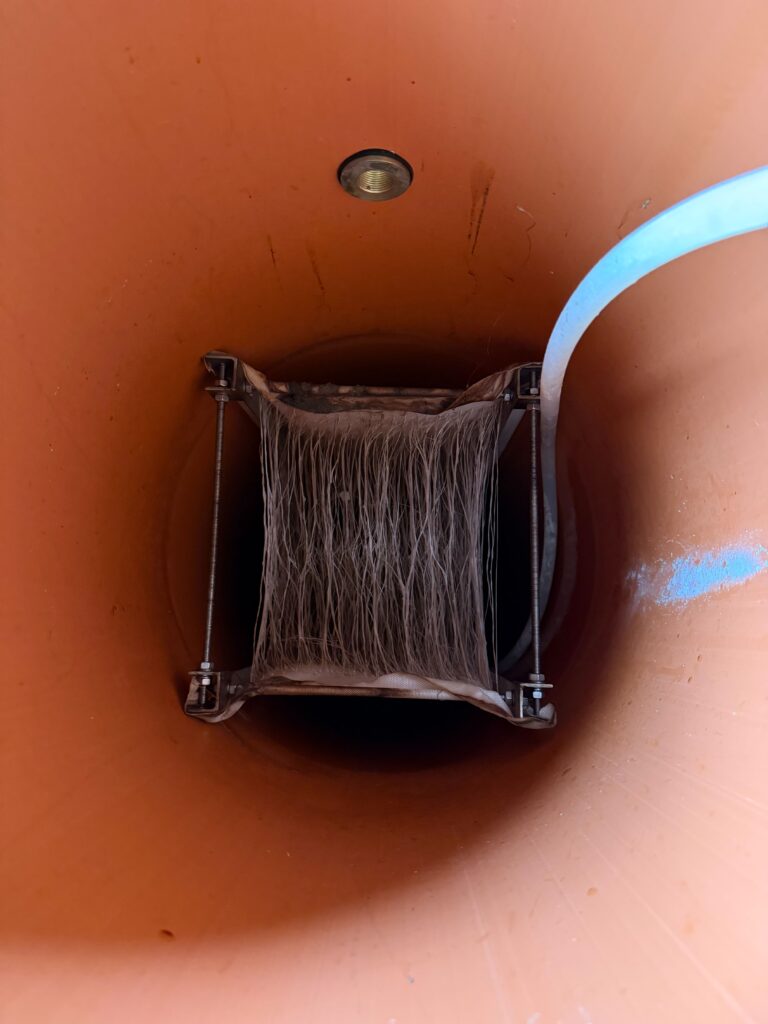
Perhaps the greatest advantage of the technology is its simplicity. Instead of expensive bioreactors, the team used large plastic sewer pipes and built its own system.
“We don’t need an expensive bioreactor costing a hundred thousand crowns. An ordinary plastic pipe is enough,” says Karel Havlíček.
This simplicity could make the solution suitable for smaller or older wastewater treatment plants as well. In larger facilities, it would not necessarily be necessary to build a separate reactor, because individual carriers could be placed directly next to one another in an existing tank.
Compared with small, freely moving carriers, they also offer a practical advantage: they can be easily removed, replaced, regenerated and later returned to operation.
The next step will be testing the technology in domestic wastewater treatment plants, whose operation can often be unstable. Large amounts of cleaning products can harm the bacteria, while at holiday cottages the microorganisms may lack nutrients during periods when no one is staying there.
A nanofibrous carrier could provide them with a more stable environment without the need to add another tank. It would simply be adapted to the dimensions of a specific treatment plant and inserted into one of its existing chambers.
Development is not over yet. The team is now carrying out molecular analyses to determine how the microbial community colonising the nanofibrous carrier differs from conventional activated sludge or other types of carriers.
The chemical results, however, have already shown that the solution works.
About the project
The project Innovative 3D Structural Biomass Carriers with Nanofibrous and Biological Components for Biotechnological Applications in Water Treatment was launched under the Czech Ministry of Industry and Trade’s Applications programme.
Project number: CZ.01.01.01/01/22_002/0001074
The project is carried out by CXI TUL, Nanotech dynamics, s.r.o., and VÚTS, a.s. It will be completed in September 2026.