
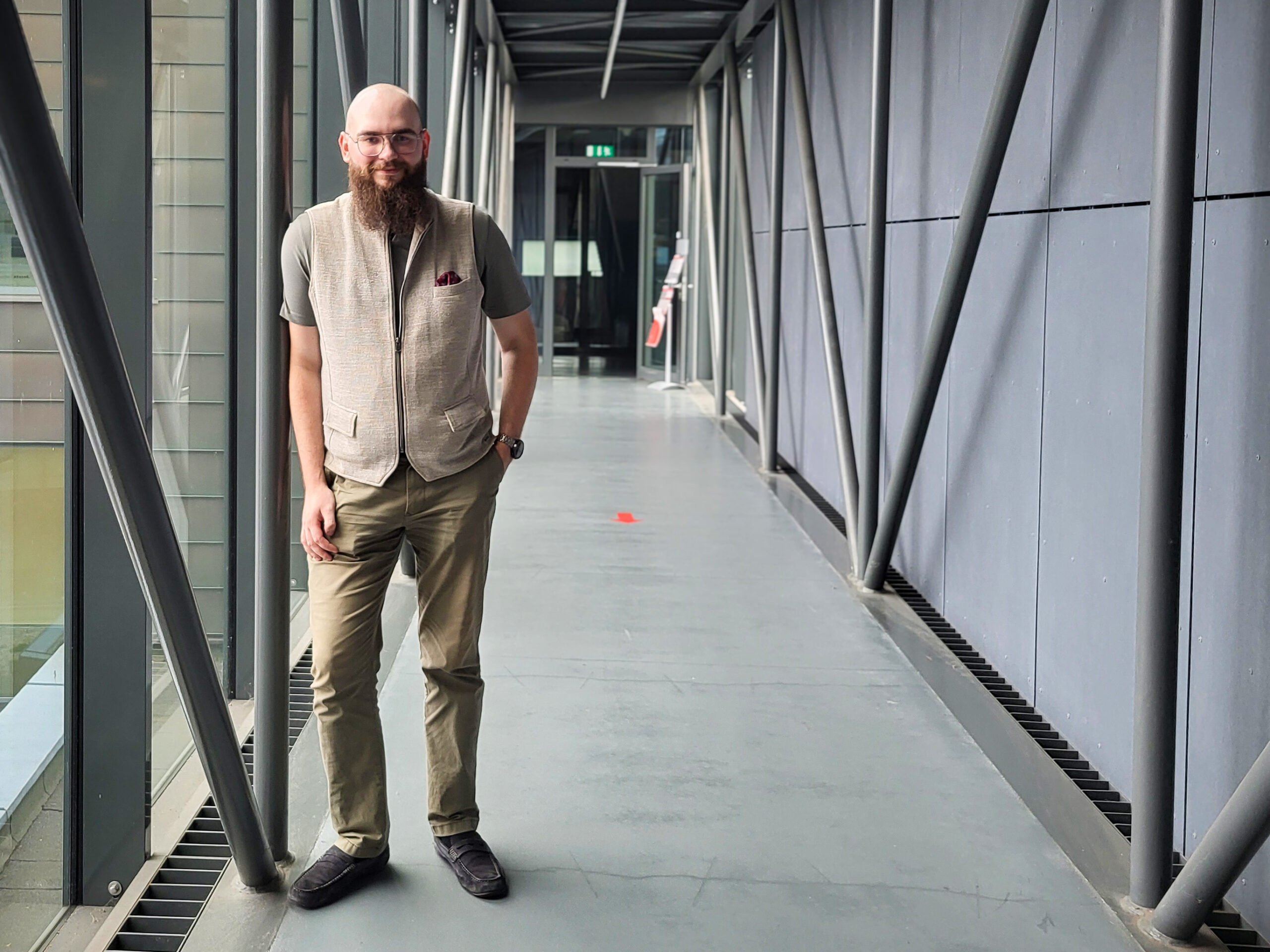
Software that helps manage a car manufacturer, monitors wastewater treatment plants, and makes research data accessible isn’t created simply by writing code. Behind every application lies architecture, data processing, and dozens of decisions that the user will never see.
This is exactly what Martin Honzátko focuses on at the Laboratory of Process Modeling and Artificial Intelligence at CXI TUL. In this interview, he describes how he got started at age eight, what he gained from studying in Vancouver, and which projects have helped him grow the most and been the most enjoyable. He also explains why artificial intelligence won’t replace programmers, but will fundamentally transform their work.
What exactly do you do, and how would you describe your work to someone who isn’t familiar with IT?
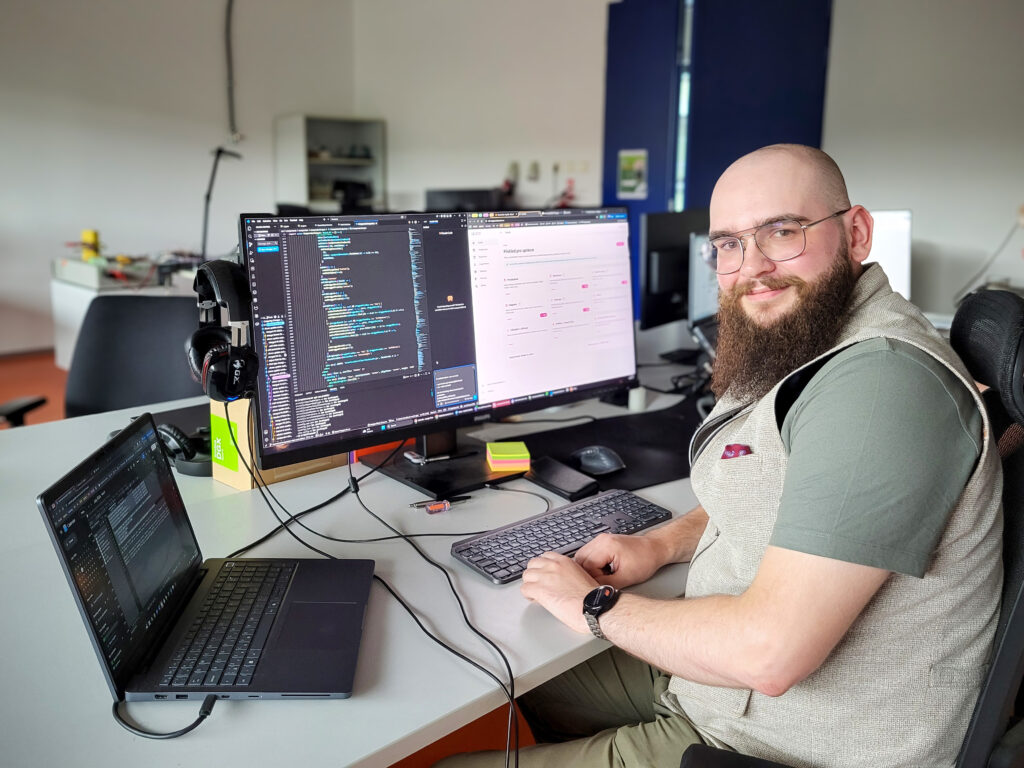
I’m a software developer specializing in web applications. I focus on both what the user sees and interacts with, and—most importantly—what happens behind the scenes: processing input data, communicating with databases, managing individual processes, and integrating all parts of the application.
Part of my job is also designing the entire system architecture. User interface design isn’t my main area of expertise, although I do get involved in it from time to time.
How did you end up at CXI TUL?
I studied at the Technical High School in Liberec, and while I was still in school, I first got a part-time job at CXI TUL. Later, I worked there as an external contractor in a lab where we developed mixed reality (MR) applications.
After that, I studied briefly at TUL, but after two semesters I decided to go to college in Vancouver for two years. After returning to the Czech Republic, I worked for some time in manufacturing as a supervisor. When a position opened up in the lab, I returned to CXI TUL, this time as a full-time employee.
Have you always enjoyed programming?
It’s been my passion since I was about eight years old. I started with small things like HTML, robotics, and microcomputers.
I was looking for a field that would fulfill me, make sense to me, and at the same time allow me to make a living. I always ended up with web applications.
How do you think studying in the Czech Republic differs from studying in Canada?
In my opinion, studying in the Czech Republic is more structured and goes into greater depth. In Canada, you had more freedom and could tailor your studies to what interested you at the time or how much time you had. When I wanted to delve deeper into a particular topic, the system allowed me to do so.
There’s a lot of talk these days about how artificial intelligence is reducing the demand for junior developers. Does it still make sense to study IT?
Definitely, but the entire field needs to adapt to the new situation. Today, artificial intelligence can handle some of the work that was previously done by a team of junior developers—and often does it faster.
However, developers remain important because AI still makes mistakes, doesn’t understand all the context, and can’t conceptualize the entire product as comprehensively as a human can. Software will always be needed. Behind everything, there must be someone who designs the system, verifies it, and takes responsibility for it.
Furthermore, there are areas—such as security or military systems—where AI cannot be freely used in development. So developers aren’t going away. But their roles and the way they work will change.
How has your field changed over the course of your career?
In a sense, it has changed a lot, but at the same time, it remains the same. I’ve experienced several major waves: artificial intelligence, virtual and augmented reality, and microservices.
New technology always generates a lot of excitement; everyone wants to use it, and later comes a period of normalization. The field then catches up with the rapid changes and looks for meaningful ways to apply them. The fundamental principles of software development, however, do not change. The field is more in a state of constant adaptation.
Which project are you most proud of?
I’m very proud of the project for Škoda Auto. It’s a large-scale internal web application called PROCOP—Production Copilot 2.0—which uses artificial intelligence primarily to support the needs of production departments. Due to the sensitivity of the information, I can’t go into complete detail, but the system currently includes approximately 20 modules.
Most modules operate on the basis of chat applications, but we also have specialized modules with specific workflows for larger-scale and specific tasks. These are custom-built according to the needs of the given department. In addition, there are integration modules for connecting to existing internal systems.
Today, PROCOP focuses primarily on AI solutions for manufacturing environments, as the name itself suggests, but the possibilities for its future applications are essentially unlimited.
How has the project progressed since its inception?
Very quickly. It began taking its current form about a year ago, and the user interface itself wasn’t developed until late November 2025. During the first half of the year, a colleague from another company and I designed the workflow and prepared the first versions of roughly ten modules.
Since then, the system has been continuously evolving based on user feedback and specific practical needs. It’s gradually becoming more integrated into day-to-day operations, and as interest grows, new modules are being added.
What has this work brought you?
It has significantly advanced my skills in software design and development. There was no well-trodden path ahead of us, so we had to find new solutions.
The system is constantly expanding and evolving, but it has great potential. I feel good knowing that this isn’t a one-off application. It can have a long-term impact on the company’s internal processes and remain in use for many years.
Which other project demonstrates the real impact of the lab’s work?
Definitely the TIVOR platform. It’s an amazing project in which colleagues from our lab have played a significant role, and I contributed to its development to a small extent. Using image analysis, it can assess the status of wastewater treatment plants.
The solution includes a comprehensive application that manages treatment plants, customers, measurements, detection, and field technicians. Users can view clear graphs showing the performance of individual treatment plants or entire groups of facilities.
It’s a great example of a system that combines artificial intelligence, image analysis, web applications, and practical operations management.
You’re also working on a system for research data. What is its purpose?
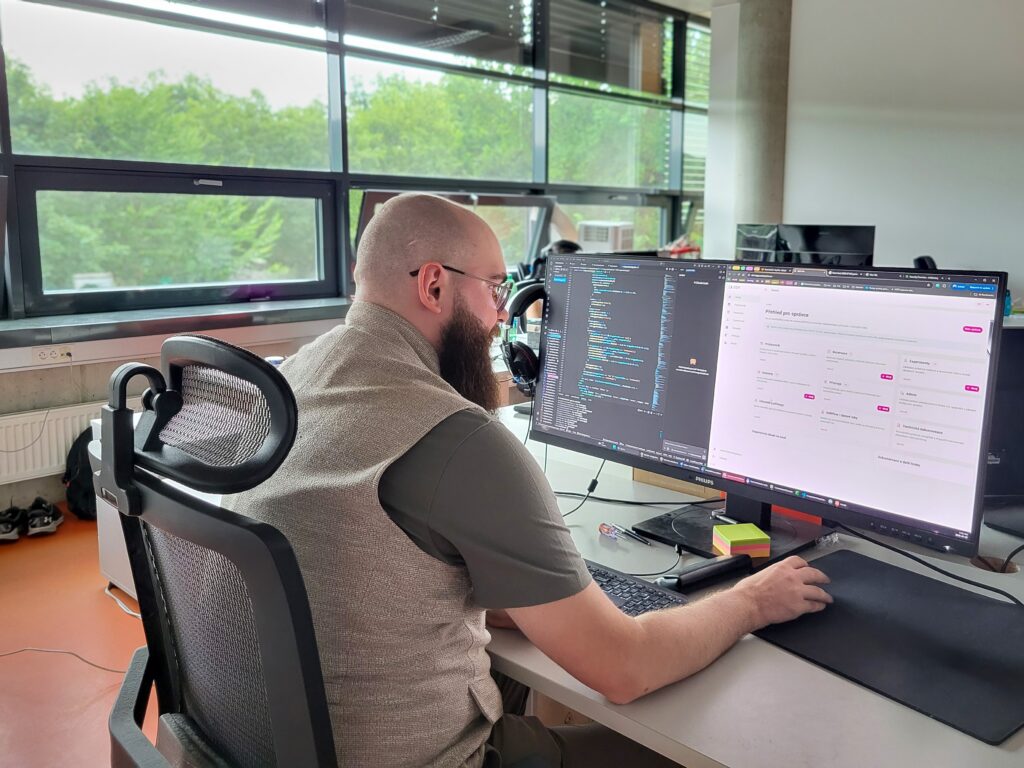
I’m working on a system called DDR. Its goal is to help researchers manage measurement results and store them in a shared database. This should facilitate the sharing of data from various research projects across the Czech Republic and Europe.
In the digital age, it’s no longer enough to have results only in an article or on paper. Data must be traceable, well-documented, and available for further use. The system is thus aligned with the principles of open science and is designed to help researchers keep their work relevant and usable.
What criteria do you use to select projects?
I usually enjoy taking on projects and tackle them with great enthusiasm, but I try to understand in advance exactly what they will entail and what technical solutions they will require.
They don’t always have an immediate practical impact. Sometimes I’m drawn to the technical problem itself, the software architecture, or the opportunity to apply a certain methodology. But practical benefits are always a big plus.
You do a lot of mental work. How do you unwind?
I like to go for walks. I don’t have a driver’s license, so I walk or take public transportation. The commute to and from work is a great way to clear my head. I also watch a movie or TV show, or go to a bar.
After work, I spend another hour or two thinking about what I did and what I’ll be doing the next day. After that, I try not to think about work anymore.